The Doctor Who Made Staunton a Medical Crossroads
An Irish immigrant’s practice near the Augusta County Courthouse trained some of the most consequential figures in American medicine and history
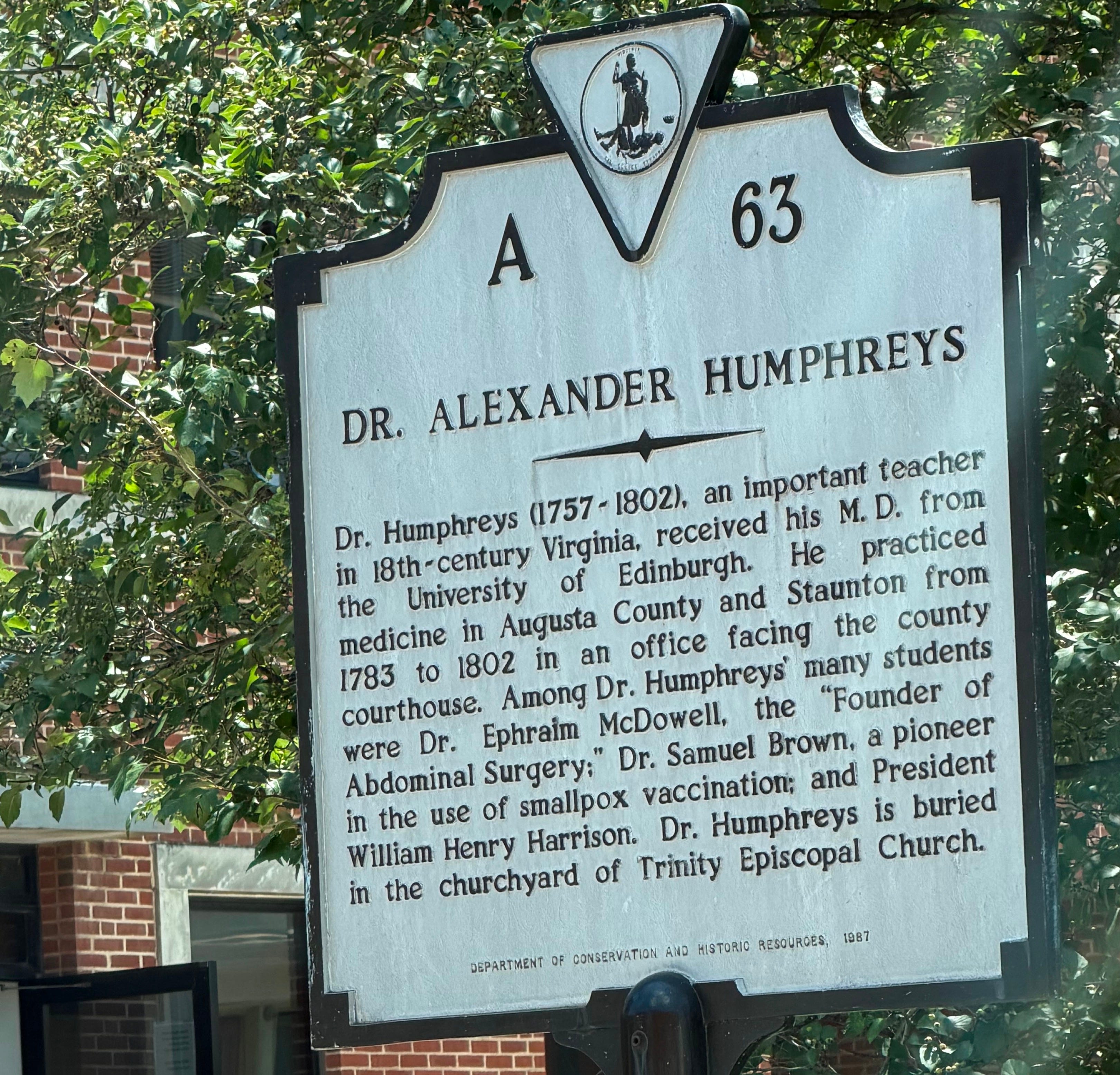
Walk past the Augusta County Courthouse on South Augusta Street and you’ll find a state historical marker that most people breeze past without a second look. Marker A-63 bears the name Dr. Alexander Humphreys, and its text is understated to the point of being misleading about just how consequential this man’s 19 years in Staunton turned out to be.
Humphreys was born in County Armagh, Ireland in 1757, the son of John Humphreys and Margaret Carlisle. He first studied medicine under his uncle before traveling to Scotland, where he earned his M.D. from the University of Edinburgh in 1782. At the time, Edinburgh had the most famous medical school in the world. He was 25 years old and had just finished training at the finest institution medicine had to offer. He could have gone anywhere.
He came to Virginia.
In 1783, Humphreys emigrated to Augusta County and settled at Greenville, near his brother David Carlisle Humphreys, who had lived in the county since 1764. In 1787, he moved to Staunton and established a practice there, setting up his office facing the county courthouse, a central location that put him squarely in the middle of Staunton’s civic and commercial life.
He wasted no time putting down roots. On March 22, 1788, he was granted permission by the County Court to build an “elaboratory” on the prison lot. The word sounds strange now but was straightforward in the 18th century: a working laboratory where he performed dissections, had an apothecary mix medicines, and trained students. It was, for all practical purposes, a small medical school attached to his practice.
Beyond medicine, Humphreys helped organize a fire company, owned a great deal of city real estate, and served on a local school board. In 1787 and 1788, the Court appointed him to examine applicants for Revolutionary War pensions. On December 20, 1791, he was recommended to be added to the Commission of the Peace of Augusta County, and he took the oaths of a justice on March 20, 1792. The Act creating Staunton Academy, passed December 4, 1792, named him as one of its trustees, and he was appointed president of the Board of Trustees on May 23, 1793.
This was a man who took his adopted city seriously.
The Students He Left Behind
The historical marker calls Humphreys “an important teacher,” which is accurate but barely scratches the surface. His known students include William Wardlaw, James McPheeters, Andrew Kean, William Henry Harrison, Samuel Brown, and Ephraim McDowell. That list deserves a bit more elaboration.
McDowell received his early education at the classical seminary of Worley and James, then spent three years as a medical student under Humphreys in Staunton. From there, he studied in Scotland at Edinburgh University and under a Scottish physician, returning briefly to Staunton in 1794 before settling in Danville, Kentucky. In 1809, working without anesthesia or antisepsis, he performed the first successful removal of an ovarian tumor in recorded surgical history. He has since been called the father of ovariotomy as well as a founding father of abdominal surgery. A regional medical center in Danville bears his name today. The foundation of that career was built in a room off South Augusta Street.
Samuel Brown’s connection to Humphreys is more than teacher and student. Brown was born on January 30, 1769, in Rockbridge County, Virginia, the eighth of eleven children of the Rev. John and Margaret Preston Brown. When Humphreys married Mary Brown on April 8, 1788, he married Samuel’s older sister, making Samuel his brother-in-law. The student in his elaboratory was also family.
Brown studied medicine under Humphreys, then as a private pupil of Dr. Benjamin Rush at the medical school in Philadelphia for approximately two years, then at Scotland’s Edinburgh University and the University of Aberdeen, graduating with an M.D. in 1794. After settling in Lexington, Kentucky, four years after Jenner’s famous discovery, Brown had vaccinated successfully more than five hundred persons in Kentucky, at a time when vaccination was still being only tentatively used in the large cities of the East. He was elected to the American Philosophical Society in 1800. He was, in short, one of the most consequential physicians in early American history, and his first teacher was the man buried at Trinity Episcopal Church.
William Henry Harrison’s connection to Humphreys is noted on the historical marker and in Wikipedia’s entry on Humphreys. A period account drawing on the Augusta Historical Bulletin adds that Harrison started his medical studies under Dr. Andrew Leiper in Richmond, then came to Staunton and continued his studies under Humphreys before entering the University of Pennsylvania, where his father’s death in 1791 cut his training short and sent him into the Army instead. The major Harrison biographies focus on Philadelphia and don’t always name Staunton, so the precise extent of his time here is difficult to pin down from this distance. What is not in dispute is that he became the ninth president of the United States, dying 31 days into his term in 1841. That a future head of state passed through a practice on South Augusta Street is not, given the remarkable density of Humphreys’ student roster, entirely surprising.
Other notable students included William Wardlaw, who became a prominent physician in Tennessee, and Andrew Kean, who served as a chief surgeon in the War of 1812.
A Family Tree That Reaches Further
The connections radiating outward from Humphreys extend beyond medicine. His wife Mary was the daughter of Rev. John Brown of New Providence Church, and her brother John Brown went on to serve as a U.S. Representative and Senator from Kentucky and as President pro tempore of the U.S. Senate. The same household that produced Samuel Brown, pioneer vaccinator, also produced a future Senate leader.
One of Humphreys’ own daughters, Elizabeth L. Humphreys, born in 1800, later married Robert Smith Todd and became the stepmother of Mary Todd Lincoln, Abraham Lincoln’s wife.
What the Marker Doesn’t Say
Humphreys died on May 23, 1802, at 44 years old and is buried at Trinity Episcopal Churchyard in Staunton. He had been in the Shenandoah Valley for less than two decades. His widow and children left for Kentucky shortly after his death.
A bronze tablet was dedicated at his grave in April 1951 by the Augusta County Medical Association, nearly 150 years after his death. The state historical marker on South Augusta Street followed in 1987. Both feel like quiet gestures toward a man whose influence was anything but quiet.
The students who passed through his elaboratory altered the course of American medicine, helped vaccinate hundreds of people against a disease that had killed millions, and went on to positions of national prominence. Staunton was the place where that training happened. The man who made it happen is easy to miss, marked only by a sign most people walk past without stopping.
Have a piece of Staunton history worth covering? Reach out to the Stauntonian at brad@stauntonian.com.