On May 7, 1889, the Staunton City Council met and passed a resolution written by council member William Purviance Tams. The city owned 85 acres behind its water pumping house, the resolution noted, and people living in small houses without yards had nowhere cool to spend a hot evening. The council voted to set the land aside as parkland and, in the same motion, named it Gypsy Hill Park, after the Romani travelers who had once camped near its springs. That word is now widely recognized as a slur against the Romani people. The council’s minutes from that day are the first place it appears attached to this ground, and the name has never changed since. The same meeting capped the initial development budget, for walks, carriage drives, and shade trees, at $1,500.
Before any of that, the land was Spring Farm, owned by a German immigrant named Peter Hanger from around 1750. During the Revolutionary War, Staunton held roughly 200 Hessian mercenaries captured at Trenton as prisoners, and Hanger put some of that captive labor to work building himself a stone farmhouse with three-foot walls in the style he remembered from Pennsylvania. The house stood at what’s now the park entrance for well over a century before it was finally torn down, empty and falling apart.
Why the Water Is There at All
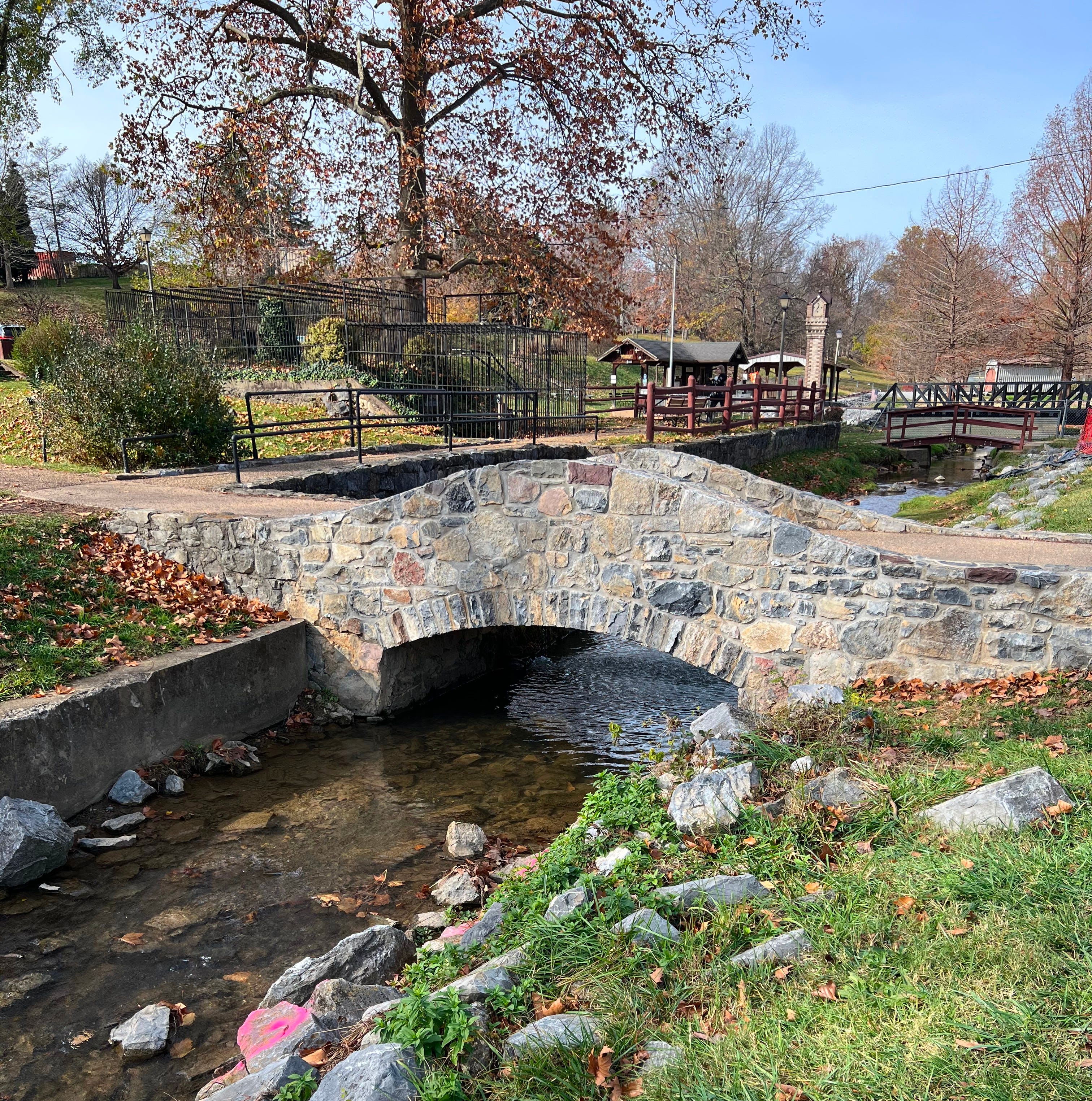
The springs themselves go back further than anyone who built on top of them. According to a geologic history compiled for the city by Kenny Bosserman, the ground under Staunton was a shallow sea roughly 500 million years ago, its sediment eventually solidifying into the limestone and shale still visible in road cuts around the city today. The collision that built the Appalachian Mountains, finished around 250 million years ago, folded and fractured those rock layers, and one of the resulting cracks, the Pulaski-Staunton fault, runs directly through the north end of the park and on through the city toward North Carolina. The fault is long dead. What it left behind is Karst, porous, degraded limestone riddled with sinkholes, caverns, and, critically, springs. Gum Spring Branch, the small stream that starts in the upper end of the park, originates from one of these openings and picks up others along its course. Some springs still surface openly, one about 45 feet downstream from the bridge near the Kiwanis Field concession stand, another beside the creek near the children’s pool. Others have been capped and sit visible today as squat hexagonal structures, one near the Kiwanis Baseball Field, another past the right-field fence of the Kiwanis May Field, a third behind the old pump house that now serves as the Stonewall Brigade Band’s building. Lake Tams, the fishing lake near the golf course, can never be fully drained, because a spring runs directly through its center. The same water source, still active, feeds the Duck Pond today.
Staunton drew its drinking supply from this exact water through the mid-1800s, and the city bought 30 acres around the springs in 1876 specifically to protect that source. By 1889 the holdings had grown to 85 acres, enough that Tams could argue the land was doing double duty, guarding the water supply and giving the city somewhere to breathe.
Hutchens and His Deer Herd
The city’s first parks superintendent did not apply for the job. Peyton Edward Hutchens was a general handyman for Staunton when he was elected one of the city’s three police officers that same May, and the new force split patrol duty at the brand-new park on a rotating weekly basis. Somewhere in that rotation, Hutchens became the only officer still assigned to Gypsy Hill, and the job grew from there. By the time the title “superintendent” belonged to him outright, he was managing landscaping, discipline, and an actual menagerie: monkeys, domestic and wild birds, and a herd of deer, formalized into a small zoo by 1893 under a dedicated park policeman. People who grew up visiting the park still sometimes mention the caged pen that once held a bear.
Hutchens has one more thing named after him, sort of. The pond at the center of the park started out as Lily Garden Pond, got renamed Hutchens Lake in his honor, and became Swan Lake sometime around the late 1940s. Most people who feed the ducks there today call it the Duck Pond and have no idea it’s had three other names.
A Grave That Was Never Moved
In 1891, the descendants of John Lewis, the man credited as Augusta County’s first European settler and Staunton’s founder, asked the city for permission to dig up his remains and his wife’s from their original burial site and rebury them in the new park, with a monument marking the spot. City council said yes that November. The monument was built. The reburial was not. Lewis and his wife are still in their original graves. The monument in Gypsy Hill Park honors two people who were never actually moved there, and as far as the record shows, nobody has fixed the discrepancy in the 135 years since.
The same families who pushed for that monument, the Peytons and Catletts, kept shaping Staunton’s parks for decades after, and one of them left a small personal record of it. Richard Catlett Peyton won the Staunton Golf Club’s Beverley Cup on the Gypsy Hill links in 1922. Decades later, his son recalled walking that same course as a boy, holding his father’s hand, listening to the story of that win, then returning to Staunton as an adult, walking the same path, and stopping at the John Lewis monument, realizing his own family had shaped the ground he was standing on. Charles Catlett’s will separately paid for the land under Betsy Bell Park, and his sister Elizabeth Gay Catlett left money that built the pool at Montgomery Hall Park, a bequest that connects directly to a much harder story about that second park, one Gypsy Hill’s own official history doesn’t mention at all.
Segregation at the Pool
The Gypsy Hill Pool opened July 22, 1932, built in forty working days by the Staunton Fire Department on an $11,000 city loan, with firefighters kicking in $1,500 of their own money. Three hundred people showed up for the ribbon-cutting, complete with diving exhibitions and a marching band. The whole project, pools, bathhouse, flood lighting, plumbing, diving tower, everything, cost $11,200 total. A new bathhouse followed in 1958, and when it needed rebuilding again in 1957, the fire department ran a carnival at the fairgrounds to help cover the roughly $32,000 cost, hoping to clear enough afterward to add a filtration system. By 1962 the pool’s lifeguard roster included Tom Payne, Sandy Gum, Wayne Hite, Randy Olsen, and John Einstein, teenagers and young adults from around the city, managed by Chick Crawford with W.W. Talley as his assistant. It is a genuinely good Depression-era and postwar story, city government and volunteer labor solving a problem fast and cheap, decade after decade, and it’s the version the city’s own park history document tells in full.
What that document does not say is that the pool, like the rest of the park, was segregated. Staunton’s Black residents were permitted to use it on one day each year, remembered locally as Negro Day. After that single day, the city drained the pool and closed it for the rest of the season before refilling it for white residents the following summer.
Montgomery Hall Park exists partly because of that exclusion. The city bought 148 acres of the old Montgomery Hall estate, built by enslaved labor in the 1820s, in 1946, and turned its operation over to a volunteer Negro Recreation Committee that raised the money to open its own pool there in 1949. The park became a real regional draw. Estimates put summer attendance as high as 18,000 people in a single season, families arriving by the busload because Jim Crow had left them nowhere else nearby to swim.
Staunton desegregated its parks in the 1960s. The gap in how the city has funded the two parks since has stayed an open sore rather than a closed chapter. This July, the city finished a $2.67 million rebuild of the Gypsy Hill pool house, replacing the 1958 building with zero-barrier access and private family restrooms. A Staunton resident wrote to Augusta Free Press around the same time, calling the bathrooms at Montgomery Hall Park “deplorable” by comparison and asking why one park got the upgrade and the other didn’t. Augusta Free Press runs more opinionated and first-person than a standard news outlet, worth knowing as you read their coverage, but the dollar figures and dates in their reporting trace back to the city’s own statements. The city has since committed $1.9 million toward fixes at both parks, including new ADA-compliant restrooms and outdoor showers at Montgomery Hall, targeted for completion before pool season opens in 2027.
Still Standing, Still Working
The Stonewall Brigade Band traces its roots to 1855, when it was founded as the Staunton Mountain Sax Horn Band, and claims the title of oldest continuously operating community band in the country. It’s carried several names since, the 5th Regiment Band during the Civil War, when many members served in the actual 5th Virginia Infantry, then the Second Corps Band, then Turner’s Silver Cornet Band, before settling on the name it earned after the war. It played the bandstand’s dedication on Arbor Day, November 1, 1889, while 1,500 trees went into the ground around it, and it still plays there most Monday evenings each summer. Along the way it’s performed at Ulysses S. Grant’s funeral in 1885 and been invited back for the dedication of Grant’s Tomb, traveled to the 1889 Washington Centennial and the 1893 Chicago World’s Fair, and marched in six presidential inaugural parades, covering Taft, McKinley, two for Cleveland, and two for Woodrow Wilson. The golf course opened in 1919 and is still one of the cheapest rounds in the Shenandoah Valley. For 25 years, the Statler Brothers played free Fourth of July concerts here to crowds reported at 100,000 people, before that tradition passed to other performers.
None of the springs that started all of this are gone, either. Several still surface around the park today, in the same spots the geologic record says they’ve always been, feeding a system nobody built to last 137 years but somehow has.