
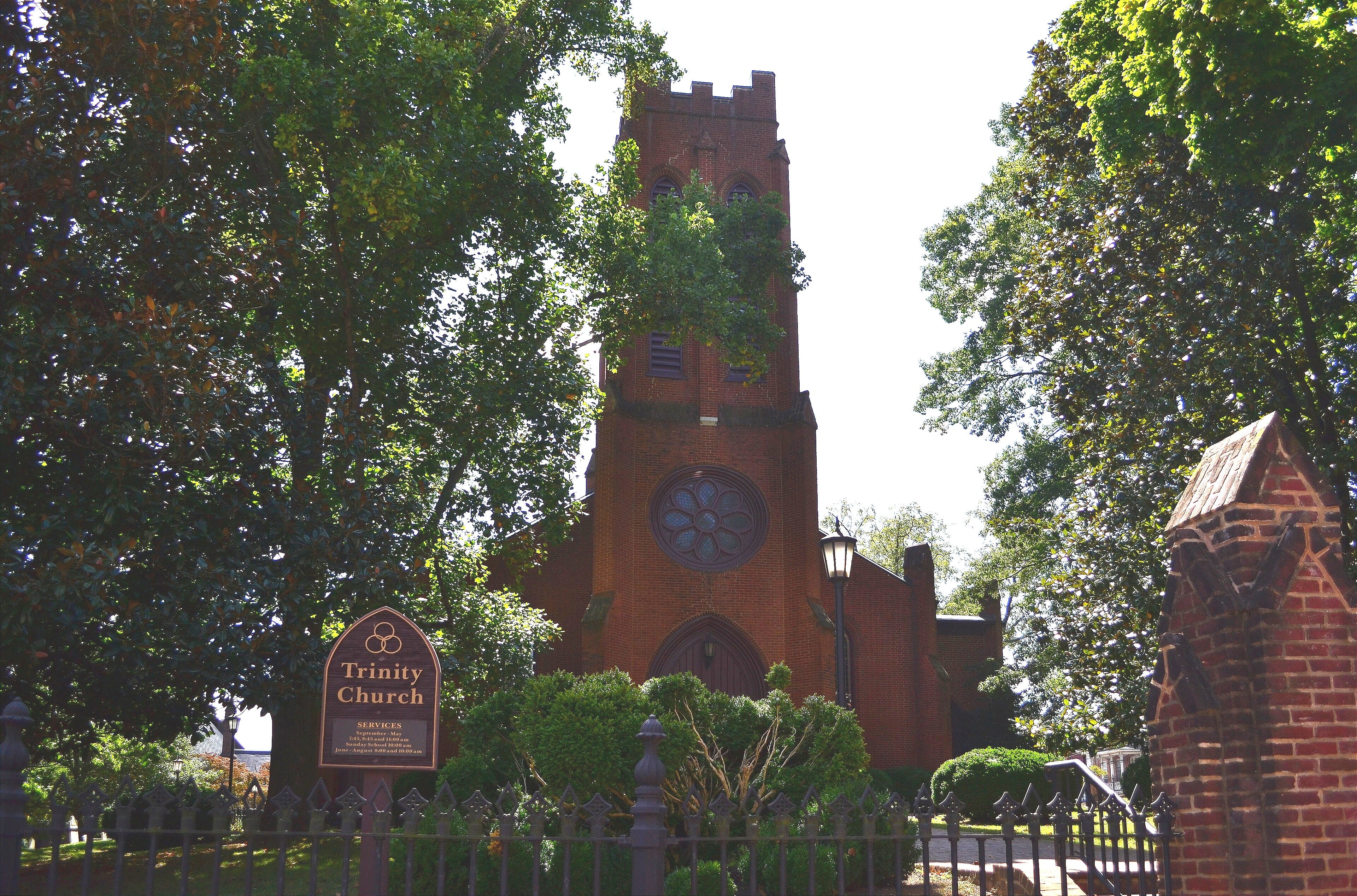
The Church That Ran a County
Trinity Episcopal was Augusta County’s government, Virginia’s capitol for sixteen days, and the keeper of a Tiffany glass collection most locals have never seen.
Sometime this month, if the schedule holds, workers will finish a million dollars’ worth of restoration at Trinity Episcopal Church on West Beverley Street. The project covers the buildings, the graveyard, the fences and walls, new interpretive signage, and an accessible bathroom and ramp, with completion timed to the country’s 250th birthday. Half the money comes from the Virginia 250 Preservation Fund, administered by the state’s Department of Historic Resources. The other half came from the congregation itself.
The timing is not an accident, and it is not just symbolism. Trinity has a stronger claim on the founding era than nearly any building west of the Blue Ridge. For sixteen days in June of 1781, this property was the capital of Virginia.
Here is how The Stauntonian works. Every Thursday, the full issue goes live for everyone. After that day, it moves behind a paywall, but a free subscription means it lands in your inbox the moment it publishes, and you can read it there whenever you want, no restrictions.
Paid subscribers get the full picture: archive access, the ability to comment on stories, participation in our live chats, and some new perks we are rolling out soon. No advertisers, no algorithms deciding what you see. Just Staunton news. Join us at stauntonian.com.
The Parish That Was the Government
Trinity was founded in 1746 as Augusta Parish, one year after Augusta County itself was organized and one year before Staunton was established. The numbers on the parish’s original boundaries sound like a misprint: they ran from the Blue Ridge to the Mississippi River, and from the North Carolina line to the Great Lakes. On paper, a single frontier congregation covered most of what became the American Midwest.
In colonial Virginia there was no separation of church and state. The Anglican Church was the established church, and when a county government formed, a parish covering the same territory formed almost simultaneously. The vestry, the parish’s governing board, functioned as the only government Augusta County had until 1780. It held the power to tax. It served as the welfare department, charged with the care of widows and orphans, and as the county’s moral watchdog.
Here is the part that says something true about the Shenandoah Valley. The settlers pouring down the Great Wagon Road from Pennsylvania were overwhelmingly Scots-Irish Presbyterians, people who had crossed an ocean partly to get away from established churches. So when Augusta Parish elected its first twelve-member vestry, at least nine of the twelve were Presbyterians, serving as officers of an Anglican parish because that was the only local government on offer. One confirmed Anglican among them, county clerk John Madison, was the father of James Madison, who would become the first Episcopal Bishop of Virginia.
Sixteen Days as the Capitol
The parish completed its first brick church in 1763, probably on the spot where the current tower stands. Eighteen years later, that modest frontier building briefly held the government of the largest state in the new nation.
In early June 1781, British cavalry under Banastre Tarleton raided Charlottesville, aiming to capture Governor Thomas Jefferson and the Virginia General Assembly, which had already fled Richmond. Warned just in time by a rider named Jack Jouett, the legislators escaped over the Blue Ridge and reconvened in Staunton. From June 7 to June 23, 1781, the Virginia General Assembly met at Augusta Parish Church, making the building, for those sixteen days, the working capitol of Virginia. A state historical marker in front of the church has told the story to passersby since 1962.
The congregation’s civic entanglements did not end with the Revolution. Six years before the legislature arrived, in 1775, citizens had gathered on the same site to debate how Augusta County would respond to the widening conflict with England.
Three Churches, One Ground
The building you see today at 214 West Beverley is the third on the site. The second went up in 1830, built partly with brick salvaged from the first. The current church, a dark red brick Gothic Revival design with an angle-buttressed tower, was completed in 1855 to plans attributed to J.W. Johns, an English-born architect who also designed buildings for the Virginia Theological Seminary. During the Civil War, the church doubled as a classroom, with seminary professors and students holding classes inside its walls as the war moved through the Valley. One later rector, Walter Q. Hullihen, who led the parish from 1872 to 1918, had served on the staff of Confederate cavalry general J.E.B. Stuart before entering the ministry.
Hullihen’s long tenure coincided with the arrival of the church’s most remarkable physical treasure. Around the turn of the twentieth century, parishioners began replacing older windows with memorial windows in opalescent glass, an American invention popularized by artists like John La Farge and Louis Comfort Tiffany. Trinity owns a dozen windows from the Tiffany studio, dating from 1898 to 1936, plus a thirteenth opalescent window from the J&R Lamb studio. Taken together with the church’s surviving 1850s diamond-pane glass and its Victorian-era windows, the collection amounts to a compact museum of American stained glass, sitting a block off the main drag, open to anyone who walks in.
The churchyard is its own archive. At least seventeen Revolutionary War soldiers are buried there. The oldest legible stone belongs to Roger North, who died in October 1776, months after the Declaration of Independence was signed.
Two hundred and eighty years after its founding, the parish has more than 500 members, hosts a free weekday lunch, and lends its campus to neighborhood associations, recovery groups, and the Staunton Music Festival. The restoration wrapping up this month is meant to carry the buildings and grounds into the parish’s fourth century. The vestry no longer collects taxes. Most people in Staunton would probably agree that’s for the best.
Local history is a new section of The Stauntonian. If there is a story, a building, a person, or an era you want us to look into, write to Brad at brad@stauntonian.com.


