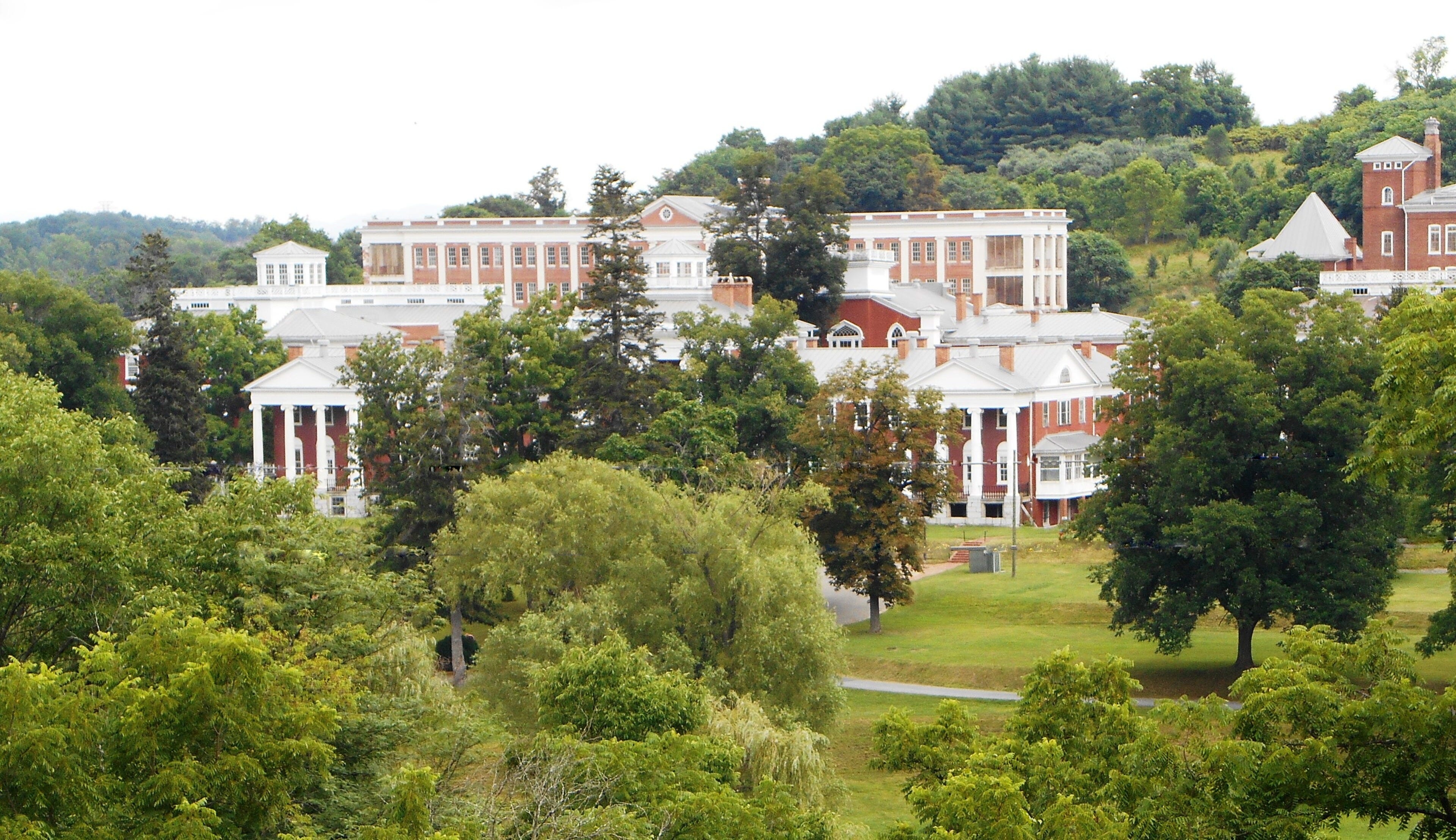
The Asylum on the Hill
Western State Hospital opened in 1828 with gardens, a cupola, and a radical idea about healing. Its two centuries since include some of the most humane and some of the darkest chapters in Virginia
The first patient arrived on the morning of July 24, 1828. He was a teacher, and the diagnosis written into the register was “hard study.” A second man was admitted that afternoon and escaped within months. The first woman came the next day, admitted for “Religious Excitement.”
Those entries opened the books at what was then called the Western Lunatic Asylum, the second public mental health facility in Virginia and one of the earliest in the country. Anyone who has stayed at the Blackburn Inn, bought a condo in the Villages at Staunton, or simply admired the domed building on the hill above Richmond Avenue has been looking at it. The complex’s afterlife as a boutique hotel and residential neighborhood is now two decades old. The two centuries before that are a compressed history of how America has treated mental illness, with Staunton near the center of the story more than once.
The Most Humane Idea of Its Time
The General Assembly established the institution by an act of January 1825, and Staunton won the site partly because of geography: the Valley Turnpike made the town reachable from across western Virginia. Baltimore architect William Small designed the original main building, completed in 1828 for a few dozen patients.
The figure who defined the institution’s first era was Francis T. Stribling, the first graduate of the University of Virginia’s medical school and, in the 1830s, the asylum’s first full superintendent. Stribling practiced what the era called moral treatment, an approach emphasizing kindness, structured routine, occupation, and a healing environment over restraint and confinement. He was one of the original thirteen founders of the organization that became the American Psychiatric Association. Dorothea Dix, the era’s great asylum reformer, visited Western State and maintained a close correspondence with Stribling for a quarter century.
The architecture was part of the therapy. Stribling brought in Thomas R. Blackburn, a protégé of Thomas Jefferson, whose additions gave the campus its Jeffersonian character: spacious wings, formal gardens, and the spiral staircase rising to a cupola and rooftop veranda that guests of the inn climb today. Even the iron fence installed in 1848 tells you something about the place’s early standing. It went up to keep townspeople out, not patients in, because Staunton residents kept picnicking on the lawns.
The Long Decline, and the Darkest Chapter
Moral treatment depended on small numbers, and the numbers never stayed small. Overcrowding pushed the institution toward custodial warehousing in the decades after Stribling’s death in 1874, a pattern repeated at asylums across the country. In 1894 the name changed to Western State Hospital. The population eventually climbed above 3,000 patients across two sites.
Then came Joseph S. DeJarnette, superintendent from 1905 until 1943, the longest tenure in the institution’s history and the most troubling. DeJarnette began as a Progressive-era reformer who banned physical restraints and unlocked patient rooms. He was also one of Virginia’s loudest advocates for eugenic sterilization. He lobbied hard for the Eugenical Sterilization Act that Virginia passed in 1924, and he testified as an expert witness in Buck v. Bell, the 1927 Supreme Court case that upheld the law and opened the door to some 60,000 compulsory sterilizations nationwide.
At Western State itself, according to Encyclopedia Virginia, roughly 1,200 involuntary sterilizations were performed during DeJarnette’s tenure, many by his own hand, and the hospital ultimately carried out about 1,700 between 1927 and 1964, the second most of any institution in the state. DeJarnette praised Nazi Germany’s sterilization program openly in the 1930s and complained to the General Assembly that the Germans were outpacing Virginia. He never recanted, even after the Holocaust was exposed. The state’s reckoning came slowly: the General Assembly formally expressed profound regret for the eugenics program in 2001, and the governor issued a formal apology in 2002.
Two Hills, Two Buildings, One Common Mix-Up
This is a good place to clear up a confusion that trips up nearly everyone, including plenty of lifelong Staunton residents. The restored campus at the Villages at Staunton and the decaying complex on the hill near the Frontier Culture Museum are not the same place.
They never were.
The abandoned building is the DeJarnette Sanatorium, founded in 1932 by DeJarnette himself as a self-supporting, semi-private hospital for middle-income patients who could pay modest fees, in contrast to the publicly funded Western State next door. The General Assembly named it after him in 1934, during his lifetime, an honor that has aged about as well as the ideas behind it. The state took the facility over in 1975 and converted it into a children’s psychiatric hospital, the DeJarnette Center for Human Development. In 1996 those services moved to a new building near Western State’s modern campus, and in 2001 the state stripped the DeJarnette name entirely, renaming the successor facility the Commonwealth Center for Children and Adolescents.
The original 1932 complex has sat empty ever since. Its windows and doors are sealed, its roof is failing, and redevelopment plans have surfaced and stalled more than once over three decades. Its dereliction, and the dark reputation of the man it was named for, have made it a magnet for trespassing urban explorers and a fixture of “haunted asylum” storytelling online. So the irony is easy to miss from the road: the building most people point to as the old asylum was never the asylum at all, and the actual 1828 asylum is the one where you can now book a room with a spa package.
Prison, Then Resurrection
The hospital moved to its current campus near Interstate 81 in the 1970s as Virginia, like the rest of the country, shifted toward deinstitutionalization. The historic campus became the Staunton Correctional Center in 1981, a medium-security prison that operated until the early 2000s. For a generation, Stribling and Blackburn’s therapeutic landscape sat behind razor wire.
The current chapter began when the state transferred the property and Richmond-based developer Miller and Associates took on the 80-acre site in 2006, converting it into the mixed-use Villages at Staunton. The first condominiums sold in 2008. The old administration building reopened in 2018 as the Blackburn Inn, inducted into Historic Hotels of America that same year, its reception desk an antique drafting table in a nod to the building’s architects. The 1865 laundry building now hosts weddings.
Western State Hospital itself is still very much a working institution, treating patients from its modern campus across town and employing hundreds of Staunton residents.
The hill it left behind holds the whole arc in its brick and iron: the founding optimism, the long overcrowded middle, the cruelty done in the name of science, and whatever it means that people now pay for the pleasure of sleeping there.
Local history is a new section of The Stauntonian. If there is a story, a building, a person, or an era you want us to look into, write to Brad at brad@stauntonian.com.