




On Oct. 27, two city staff members sat down with about 30 members of the Staunton High School FCCLA chapter and read them three statements.
Staunton teens have nothing to do.
Students do not have a plan after graduation.
Most young people leave Staunton.
The students could agree, disagree, or land somewhere in the middle, according to the city’s October 2026 activity report. What they said, the report adds, will help shape the city’s Economic Mobility Action Plan.
Jessica Blythe, assistant director of economic development, and Anna Leavitt, the city’s economic mobility and opportunity special assistant, ran the session. The report does not say how the students answered, and the city has not published a tally.
Anyone expecting a verdict on whether teenagers like living here will have to wait.
The job behind the questions
Leavitt started in January as the first person to hold her position, WHSV reported. A competitive private grant administered by the International City/County Management Association pays for it, with support from the Gates Foundation, and the city says it costs local taxpayers nothing. Economic Development Authority minutes from August 2025 describe a 2.5-year position and say Staunton was one of 16 local governments to win the award, per the minutes.
Her assignment is to link city departments with nonprofits, employers and regional partners so that gaps in housing, workforce development, transportation and child care close faster, per WHSV. The city’s own announcement frames the problem in two numbers: about 42 percent of Staunton households are cost-burdened by housing, while local employers struggle to fill open jobs, according to the city’s release.
The plan itself is now moving through procurement. The city’s purchasing page lists a request for proposals titled Economic Mobility Action Plan, open from Aug. 21 to Sept. 4. We don’t know who won the contract or when a draft is due as of this writing.
What the school’s own numbers show
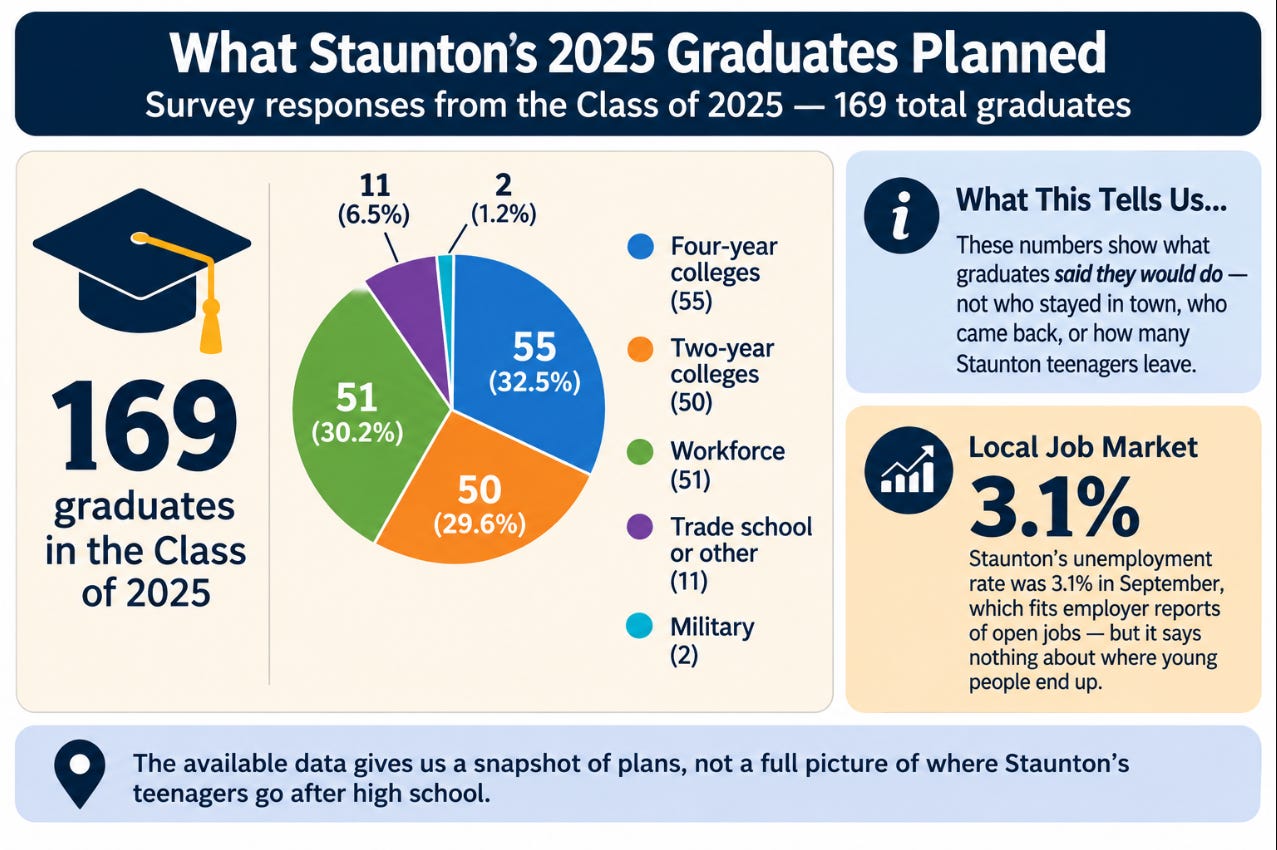
The three statements are claims about teenagers, and Staunton has some data on one of them. When the Class of 2025 graduated, 169 students received diplomas, Augusta Free Press reported, citing the school division. Fifty-five planned to attend four-year colleges, 50 two-year colleges, and 51 planned to enter the workforce. Eleven were headed to trade school or other programs, and two to the military.
Those counts show what graduates said they would do. They do not show who stayed in town or who came back, and nothing we found measures how many Staunton teenagers leave. The activity report puts the area’s unemployment rate at 3.1 percent in September, which fits the employer complaint about open jobs but says nothing about where young people end up.
Where this goes next
A 30-student conversation is a small sample, and an FCCLA chapter, which draws students interested in family and consumer sciences and career skills, does not speak for every teenager in the building.
Each statement points at a different gap: things to do, a path after graduation, and a reason to stay.
Residents who want to follow the plan can contact the Office of Economic Development at 540.332.3869.
We will report the students’ answers when the city releases them.
Source: City of Staunton, October 2026 Activity Report (released November 2026).