



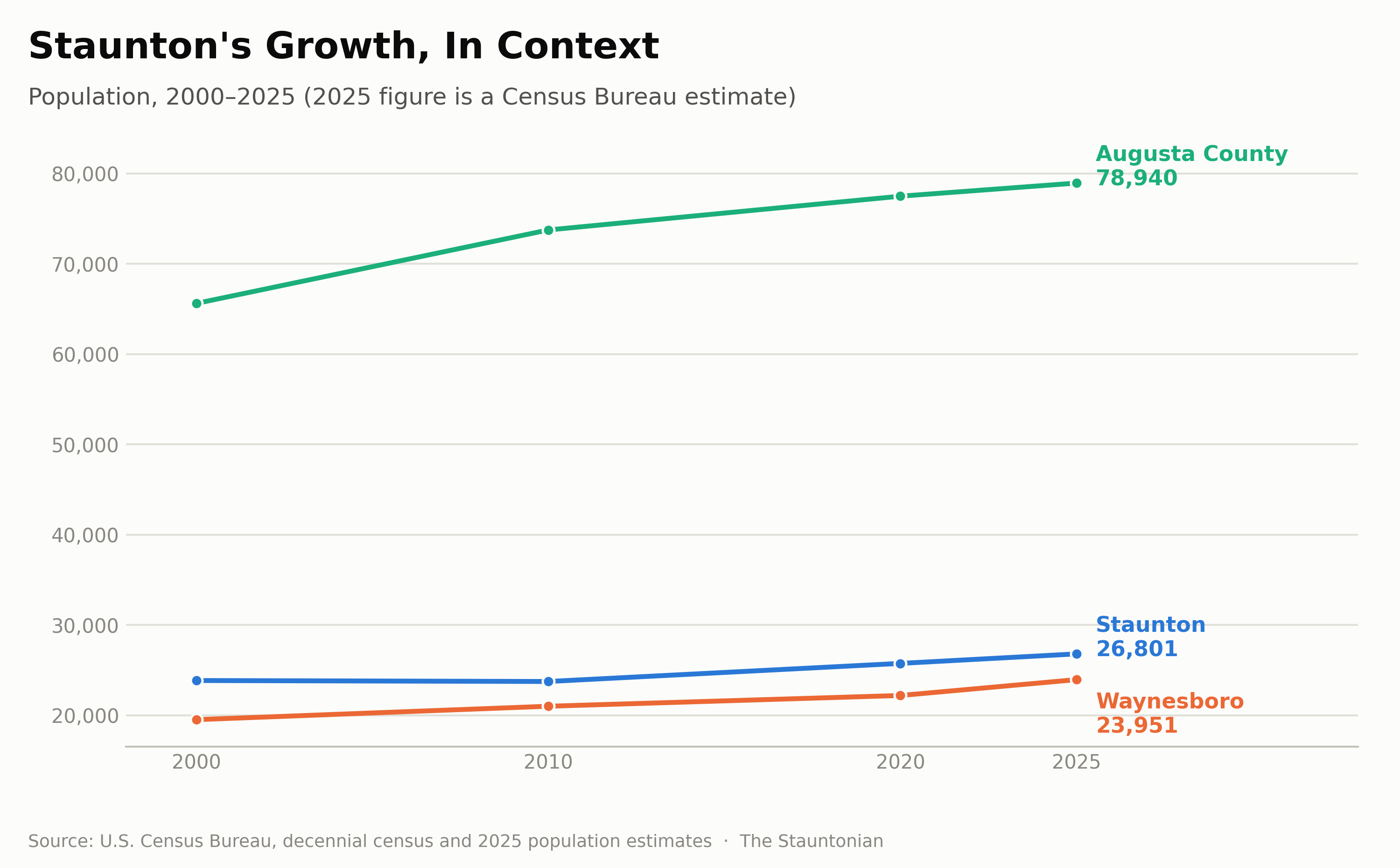
Staunton’s population hit 26,801 people in the Census Bureau’s newest estimate, dated July 2025 and released this year.
That’s up from 25,750 at the 2020 census, a 4.1 percent increase in five years, according to the Bureau’s QuickFacts release. Set against Staunton’s own history, the number is modest.
For most of the 2000s the city barely moved, holding between 23,700 and 23,900 residents for a full decade, per the Bureau’s Population Estimates Program figures compiled by Neilsberg. Then, between 2010 and 2020, Staunton added more than 2,000 residents, an 8.4 percent jump, based on the decennial census figures. The five years since have kept pace rather than slowed.
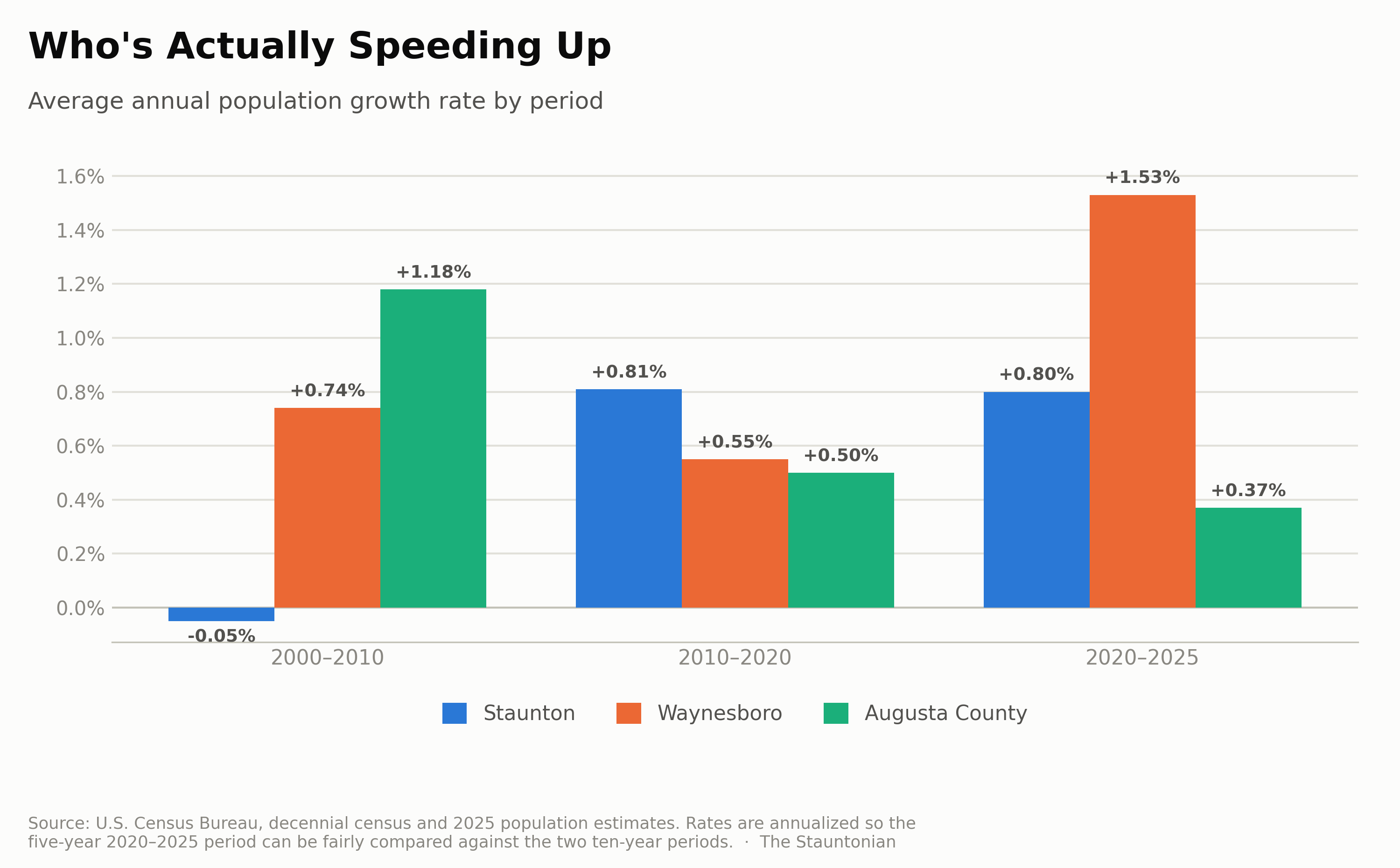
Measured as an annual rate, the standard way to compare a five-year stretch against two ten-year ones, Staunton grew about 0.80 percent a year from 2020 to 2025, almost identical to the 0.81 percent a year it grew from 2010 to 2020.
Waynesboro and Augusta County lived through the same stretch differently. Waynesboro’s annual growth rate more than doubled, from about 0.55 percent a year in the 2010s to roughly 1.53 percent a year since 2020, according to the Bureau’s Waynesboro table. Augusta County went the opposite way: 1.18 percent a year from 2000 to 2010, down to 0.50 percent from 2010 to 2020, and just 0.37 percent a year since 2020, per county figures. For most of the twentieth century, people left the cities for the county, chasing cheaper land. The last five years didn’t just reverse that pattern; they show the reversal picking up speed in Waynesboro while the county keeps losing steam.
The people moving into Staunton also look different than they did twenty years ago.
The Hispanic and Latino share of residents rose from 1.1 percent in 2000 to 4.8 percent today, and the share identifying as two or more races grew from 1.4 percent to 6.7 percent, based on figures drawn from the 2000 and 2020 census and the Bureau’s current release. Staunton remains 79.3 percent white today, according to that same release. Both of those minority populations were each under one and a half percent of the city in 2000. Twenty years later, neither is.
The growth also caught the region’s own long-range planners off guard. The Central Shenandoah Planning District’s official population projections, built by the University of Virginia’s Weldon Cooper Center for Public Service in 2017 and still the numbers the region plans around, put Staunton at 25,378 people in 2025, according to the district’s projection tables. The actual count came in 1,423 people higher, a 5.6 percent miss. Waynesboro’s projection undershot by a similar margin, forecasting 23,167 against an actual 23,951, off by 3.4 percent. Augusta County’s projection landed within half a percent of the real number. The same projections run out to 2045 and currently show Staunton essentially flat for the next twenty years, a forecast the city has already broken five years into the window.
None of that growth has come cheap.
Staunton’s median home sale price has run about $324,800 for the past several months, up 12 percent from a year earlier, the figure this newsletter has tracked weekly through Redfin. Median household income sits at $65,581 and the poverty rate at 12.4 percent, both from the Bureau’s current release. Waynesboro’s numbers sit close behind: median income of $59,994, an 11.8 percent poverty rate, and a median home value of $245,500.
Waynesboro has already had to act on the mismatch that kind of growth creates. A regional housing study found that one- and two-person households make up 65 percent of the city; roughly 70 percent of its housing stock has three or more bedrooms, most of it built for a different kind of family than the one now moving in.
City Council responded by voting 5-0 on January 14, 2025 to legalize cottage court housing, clusters of small homes built around a shared green space instead of one house per standard lot, according to Augusta Free Press. Mayor Kenny Lee called the change “promising. It gives us that potential to address affordability.” Nothing guarantees a developer builds one yet, but the zoning is now on the books specifically because the housing stock the city built for one population no longer matches the one it has.
City Council adopted the Staunton 2045 Comprehensive Plan this month, the document that sets zoning and capital spending priorities for the next two decades. A comprehensive plan is only as good as the growth assumptions baked into it, and the same regional projections behind Staunton’s plan had already undercounted the city by five and a half percent by the time the plan was adopted. Waynesboro solved one version of this problem by changing its zoning code. Staunton’s own housing strategy, still being finalized by the city’s planning staff, is the document that will show whether it plans to do the same.