

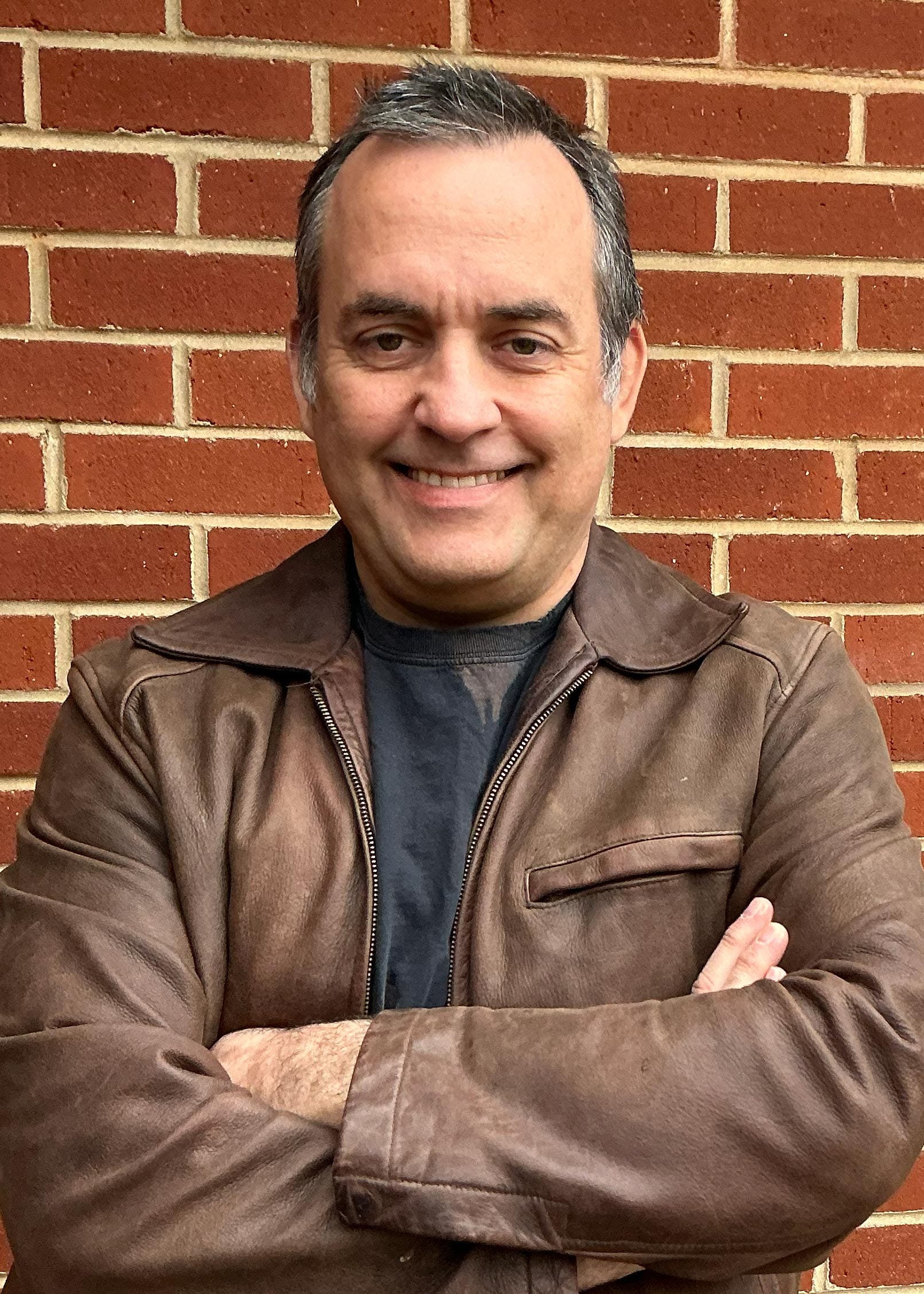
Ask Matt Warner what he does for a living and watch a man run out of nouns.
Novelist, filmmaker, audiobook narrator, game designer, jiu-jitsu instructor, website designer, father of two. A student at the gym put the question to him the other night, and he answered with some indecisive gawping before settling on “jack of all trades, master of none.” His catalog, which lives at MatthewWarner.com, suggests the second half of that phrase needs editing.
Warner has lived in Staunton since 2005, and the town keeps turning up in his work. It shows up as a fictional City of Augusta with the Clocktower on the cover, as a house on Alextine Drive lent to a novel’s hero, and in essays about the Citizen Police Academy and the DeJarnette Center. With Halloween ten days away, we asked him about the scariest thing he has written, the horror trope he would like to retire, what to read this month, the 40-minute animated film that took two and a half years, and how a working creative thinks about AI. His answers run funny, blunt, and in one case, tearful.
Here is how The Stauntonian works. Every Thursday, the full issue goes live for everyone. After that day, it moves behind a paywall, but a free subscription means it lands in your inbox the moment it publishes, and you can read it there whenever you want, no restrictions.
Paid subscribers get the full picture: archive access, the ability to comment on stories, participation in our live chats, and some new perks we are rolling out soon. No advertisers, no algorithms deciding what you see.
Just Staunton news.
You live in Staunton, write horror fiction, make animated films, design games, do voiceover work, and teach Brazilian jiu-jitsu. How do you describe yourself when someone asks what you do?
A student asked me that the other night at jiujitsu. I made indecisive gawping sounds until I told him I work as a website designer for a living and that I’m an independent filmmaker on the side. A more honest answer might be that I’m a jack of all trades, master of none. This afternoon, I was a music composer, sitting at my piano and writing a lead sheet, trying to figure out what key my song was going to be in. I spent half that time cursing and wishing for a real composer to do it for me. I’m also the proud father of two wonderful teenaged boys, Owen and Thomas. And I’m a passionate left-wing voter.
You and your wife Deena run a design business together while each pursuing your own creative work. What does that look like day to day?
We’ve been married 23 years and business partners for 19. When people hear that, they react, “I could never work with my spouse!” but the arrangement’s been very good for us. As a partner in Deena Warner Design, I’ve generally handled contracts, finances, and some client website updates while she does all the meaty design and programming work. Every Monday, we meet for an hour to review to-do lists and calendars, and that’s when we also cover family business. (E.g., “Can you take Thomas to Kendo for me tomorrow night?” “Where are we having dinner this Friday?”) I think it’s the secret to our marital success. That, and of course I’m dead sexy.
As for our creative work, I’m a morning person, while she’s a night owl. I wake up in the 5 a.m. hour to fart around with my projects before starting website work. By the evenings, I’m usually fried and/or headed to jiujitsu class, but that’s just when Deena is getting going with her personal artwork and writing. She grinds hard all day and looks forward to the nighttime relaxation of being able to work on her own stuff.
Does Staunton and the rest of the Shenandoah Valley make it into your work? There’s a lot of history here obviously, like the Civil War, old farms, and mountain folklore.
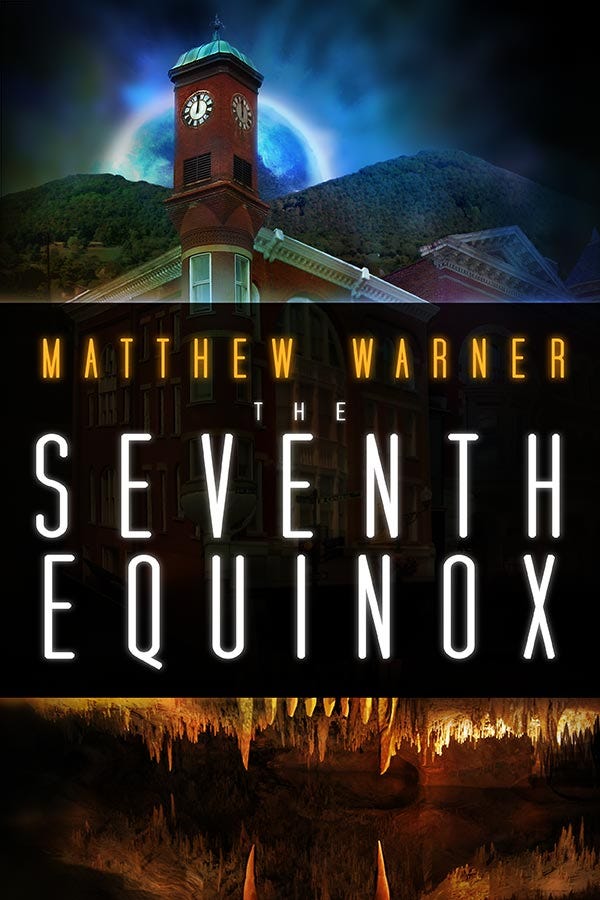
My sixth novel, The Seventh Equinox, is set in the “City of Augusta,” which is in the “County of Staunton,” and features the Clocktower in its cover art (designed by Deena, of course). I only swapped the names because I wanted a little freedom with setting detail. The Mari Bell (not Betsy Bell) mountain near that city is much the same as ours, except a giant bear sleeps beneath it in a cavern. The bear plays a critical role in a fertility rite that must occur during every seventh spring equinox, or our planet will slowly die.
My non-fiction collection, Horror Isn’t a 4-Letter Word: Essays on Writing & Appreciate the Genre, has a lot of Staunton love in it. It’s a collection of my articles written for the Horror World website and includes accounts of moving here in 2005, a report on attending the Staunton Citizen Police Academy, a rant about local politics, plus stories about urban explorations of the DeJarnette Center and Crozet train tunnel. Oh, my god. I can’t believe those articles are now 20 years old.
What’s the scariest thing you’ve ever written? What the piece that genuinely unnerved you while you were making it?
You might expect me to say this-or-that horror novel or story, but it’s actually a dark alternate world fantasy titled Empire of the Goddess. It’s a first-person story about Thomas Dylan of Staunton, Virginia, who coincidentally happened to live in the same exact house I used to inhabit on Alextine Drive. In the audio book that I recorded, he speaks with my voice. (Another strange coincidence, I know.)
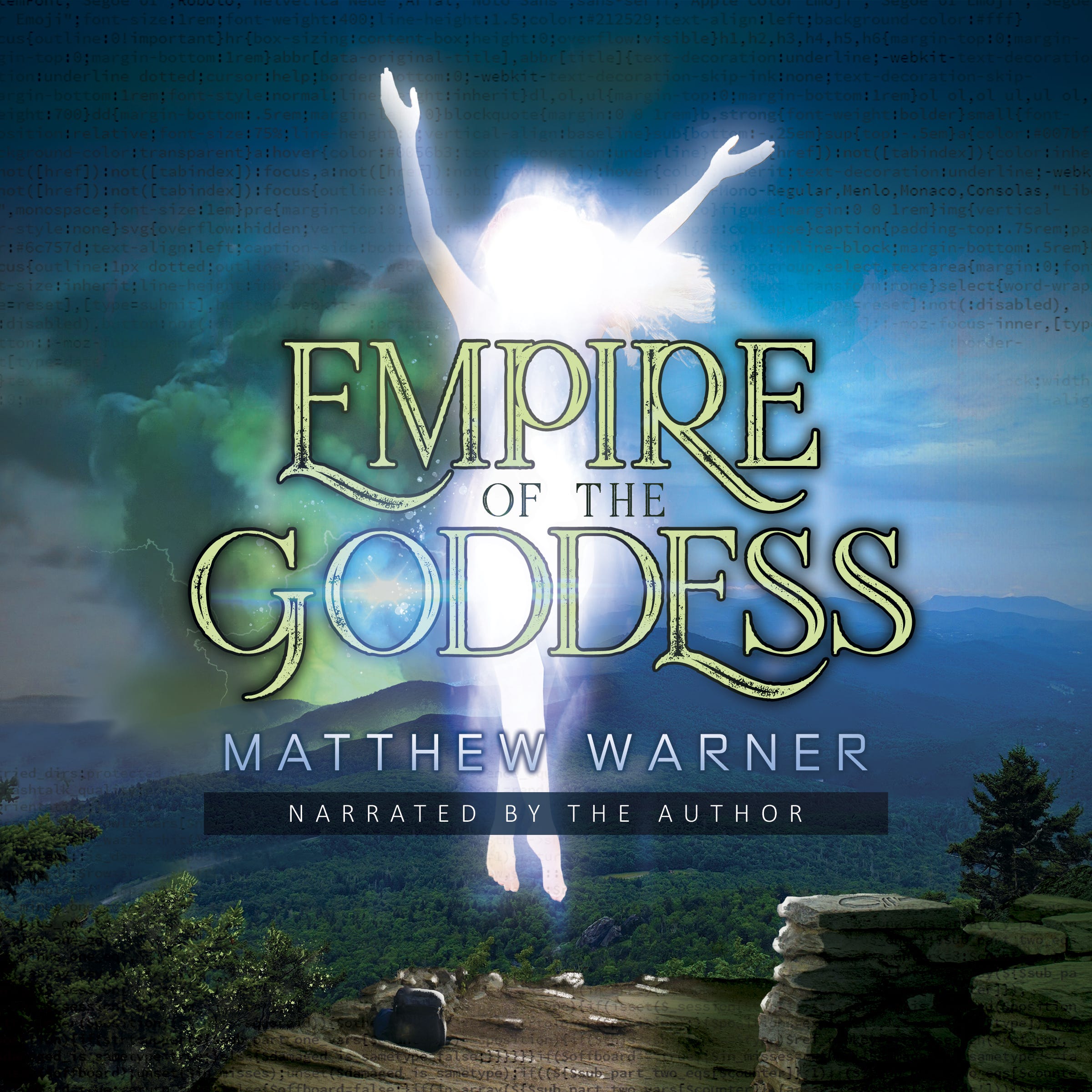
Anyway, at about the time my son Owen was four years old, Thomas Dylan’s son Walter was also four—and in chapter 1, Walter disappears from their back yard without a trace. Just gone. No clues. Stories about children in peril still get to me. I sobbed the first time I tried recording that chapter. Fortunately, he discovers his son has been abducted to an alternate version of America ruled by a brutal theocratic regime practicing human sacrifice. It’s still one of my favorites.
Is there a horror trope you’re tired of, and one you think is criminally underused?
I’m very tired of self-referential stories that are so devoid of fresh ideas that they must parody past horror tropes. “Cabin in the Woods” did it successfully, but there haven’t been many others worth a rewatch. I really like stories that bring in monsters and mythology from non-Western cultures and writers. But honestly, what I crave the most in all genres is simply a good, well-crafted tale that balances plot development with character arc. The purpose of a story is for a character to change in some meaningful way. Plot and character are yin and yang to each other: each needs the other to roll forward.
What's your recommendation for someone who wants to read something genuinely frightening this October?
My flippant but heartfelt answer is the daily newspaper. That’s the only reading that genuinely frightens me these days.
But if you want some good escapist reading, I don’t have a lot of horror cred these days, so I won’t pretend to know what’s new and hot. I can, however, recommend a few of my all-time favorite books, not necessarily scary:
The Sculptor by Scott McCloud. It’s a graphic novel about a young man’s Faustian bargain to gain the power to sculpt anything he wishes. McCloud also wrote the seminal non-fiction book, Understanding Comics, which of course is in comic-book format.
Replay by Ken Grimwood. It’s a time-travel novel in which a man repeatedly relives the last 25 years of his life, each time retaining the memories of his previous loop and being able to make new choices. Repeat by Neal Pollack has a similar premise and is also a wonderful novel.
Ready Player One by Ernest Cline is one of the few books I’ve read more than once because I loved it so much. I was also a child of the 80s, so I understood all the cultural references. The novel is ten times better than the movie.
Zealot: The Life and Times of Jesus of Nazareth by Reza Aslan is a challenging, thought-provoking non-fiction book and was the spark that lit the fire for Empire of the Goddess. I recommend it highly to all open-minded readers. I put it in the same category as The Origin of Consciousness in the Breakdown of the Bicameral Mind by Julian Jaynes because they both caused me to stare vacantly at the ceiling in existential horror.
The Fifth Science by Exurb1a is a wonderful collection of stories that do what science fiction was meant to do: ask hard questions about the intersection of humanity and its technology.
Fireflies by David Morrell horrified me for the same reason the subject matter of Empire of the Goddess horrified me. I read it long ago while holding onto the ceiling strap of a train car of the Washington Metro. The other commuters gave me some side-eye because I was just standing there, crying, as I read. It’s a wonderful book, and I’ve met David, who is a wonderful man.
You made the whole film The Cryonic Pharaoh yourself using Unreal Engine, a game development tool. How long did it take, and what did a typical work session look like?
The film’s accompanying “documentary” at this link tells it more colorfully, but the film production took about two and half years. It was only a 40-minute animated film, but I didn’t know diddly squat about 3D animation or anything about Unreal Engine. The only thing in this world more hideously complicated than Unreal Engine was the instruction manual to Owen’s first car seat. (Its counterpart is Blender, which is also free to use for indie filmmakers.)
Projects of that long of a horizon — and this includes novels — are only achievable by walking little baby steps, endlessly, until you reach the goal. On a good day, I might don my mocap suit and capture a scene’s action and then import it into my UE project. On a bad day, I would spend my one to two available hours cursing as I searched for the reason why the movie-render queue was crashing my computer.
I bit off way, way more than I could handle for that project. I should have learned on a smaller project. But I am both an Aries and an Ox, depending on what zodiac system you subscribe to, so I tend to bash my head endlessly, stupidly against walls until they break.
The film is free on YouTube. What do you hope people do after they watch it?
Pump their fist in the air and say, “F*k yeah! That was awesome!” followed shortly afterward by, “What else has this guy done?”
You wrote a year-end piece about AI at the end of 2025. As someone who creates across so many mediums, how are you thinking about what it means for creative work?
I think about this every day because it intersects both my creative and professional lives. The first thing I’ll say is I urge everyone to educate themselves. This is a rapidly evolving technology, and most people’s understanding of it is based on six-month-old information, which is laughably out of date. Watch someone on Youtube who’s not trying to scare you. I enjoy Tim Simmons of Theoretically Media. Hell, open up your ChatGPT, put it into realtime voice-conversation mode, and tell it what you think. I guarantee the experience will be memorable.
This debate seems to fall along “assistive” versus “generative” artificial intelligence lines. Assistive would be like what I’m now doing as a website designer for fire departments, when I hook up Claude AI directly to a website I’m developing and then conversationally tell it what I want. It has saved me unbelievable amounts of time in coding and debugging stuff, which has made my freelance employer happy because I work by the hour. (Did I mention that in addition to partnering with Deena that I’m a part-time employee of Responder MAX in Richmond? I spend a lotta time talking to firemen, believe you me.) Assistive AI includes scientific analysis of things like astronomical and medical data. I don’t believe creatives object as strongly to assistive AI as they do generative AI.
On the generative AI half of the debate, creatives should decide to what degree they’re comfortable using the tools. Where do they draw the line? For instance, I get pissed off whenever ChatGPT presumes to write something for me unsolicited. So I specifically prompt it to function as my dramaturg or creative writing coach. Help me discover my story by asking me leading questions framed upon the Syd Field three-act paradigm. We often have lively discussions, but I get the most value out of it when I’m having trouble deciding between this or that, and I need a considered list of pros and cons for each. At other times, I deploy it as my research assistant. Sometimes, I feed it the script for a scene and ask it to generate a reference image in so-and-so style that I can then use as a keyframe within a Kling or Seedance video renderer -- and nope, that looks like garbage, Chat. You gave her three arms! And I need it to be a mid-shot from the right side, with the door on the left, and why don’t you AIs know the difference between right and left?
So there’s a lot of iteration and direction still in my workflow. I use AI tools like they’re my private film crew, directing each department until they give me what I want. Alternatively, I would have to spend a ton of time and money trying to do the accomplish those things in the traditional ways.
That’s what AI means for my creative work, but what it means generally is anyone’s guess. I think all viewpoints and objections deserve to be addressed. The writer who had two novels and one short story pirated by Anthropic (and yes, that person was me) will get his class-action payout from Bartz v. Anthropic, and woe betide to others who presume to similarly pirate my copyright-registered work as training data. The artist who refuses to use any AI assistance whatsoever because he believes the technology cheapens the artform or encourages further intellectual property theft should also be heard. The local government who justifiably throws a fit because a data farm ran its frigging diesel generators all night, polluting their neighborhoods, should also be heard, and so should the neighbors who worry about data centers’ exorbitant water consumption. (Note for those people: look up “local LLMs” as an alternative.)
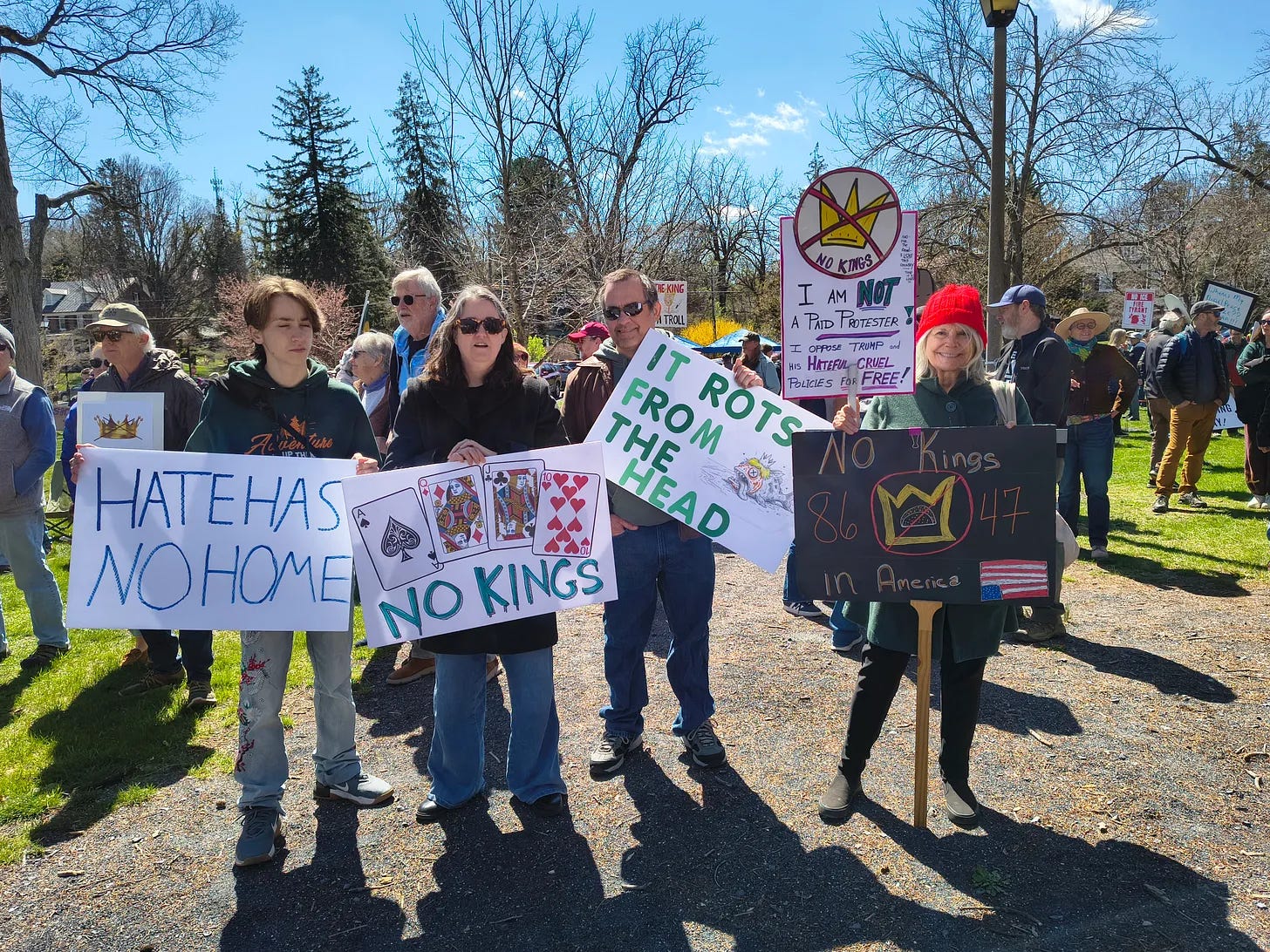
In short, I think our dysfunctional federal government should do more than call people the enemy for not using its preferred branding for AI. What nonsense. An agency like the FCC needs to be established one month ago. Any new, transformative technology raises serious societal issues, and this one in particular deserves more than hypocritical thoughts and prayers.
Are any of these dangers going to stop me from learning all I can about this technology and trying to incorporate it into my creative toolset in an ethical way? Hell no. That smacks too much of needing somebody else’s permission to be an artist. And you don’t need anyone’s permission to pursue your dreams.
What's next, and how can people in the Staunton area support what you're doing?
What’s next is I’m currently having a good time submitting screenplays and short films to competitions. I find the constraints of a contest’s rules -- and the possibility of cash prizes -- to be great way to focus.
To support what I’m doing, please explore my website MatthewWarner.com and sample its wares. There’s a ton of audio, visual, printed, and interactive matter to enjoy, as well as most of my back catalog of horror, science fiction, and fantasy books. Post comments on my blog entries and YouTube videos, and let me know you’re out there. An artist’s greatest joy is to share his work with others.