Mary Baldwin’s Financial Reckoning, Explained
A look at what Standard 13.3 actually requires and what comes next for the university.
The news arrived last Friday. On June 26, 2026, the Southern Association of Colleges and Schools Commission on Colleges — the regional accrediting body known as SACSCOC — placed Mary Baldwin University on Probation for Good Cause for a period of 12 months. The cited reason: the university failed to meet Standard 13.3 of SACSCOC’s Principles of Accreditation, the standard governing financial responsibility.
The institution has held SACSCOC accreditation without interruption since 1931. That nearly century-long record makes this one of the more significant moments in the university’s recent history.
What Probation for Good Cause Actually Is
The phrase sounds bureaucratic, but it carries real weight. According to SACSCOC’s sanction policy, probation is a more serious sanction than a Warning and is considered the last step before an institution is removed from membership entirely. An institution can reach Probation without having first received a Warning, if the Board of Trustees judges the noncompliance serious enough.
Under that same policy, institutions are typically allowed up to two years to correct deficiencies before facing further action. The “Good Cause” designation allows for a 12-month period if the board finds evidence of meaningful recent progress and a credible plan to reach compliance.
The clock is running.
What Triggered It
Mary Baldwin’s own accreditation page confirms the university was placed on probation for failing to meet Standard 13.3, which governs financial responsibility under SACSCOC’s Principles of Accreditation. The full public disclosure statement is available through the SACSCOC Box document portal.
Standard 13.3 is not an obscure technical checkbox. It requires institutions to demonstrate that they manage their finances in ways that protect students, support their mission, and sustain long-term operations. It is, in plain terms, a finding that the institution’s financial house is not in order.
Mary Baldwin is not alone in this. SACSCOC’s June 2025 accreditation actions page shows that Emory and Henry University in Emory, Virginia was placed on Probation for Good Cause at that same meeting. The pattern points to pressures that many small, private, tuition-dependent institutions in the South and Mid-Atlantic have faced since the pandemic reshaped enrollment demographics.
What This Does Not Mean
Mary Baldwin has not lost its accreditation. Students can still enroll, receive federal financial aid, and earn degrees that carry full institutional recognition. Accredited status with a U.S. Department of Education-recognized institutional accreditor is what makes federal student aid available, and that pipeline remains open.
The university’s accreditation page includes a set of frequently asked questions covering what the probation means for current students’ degrees and enrollment status. Anyone with direct concerns should read that page and contact the university.
Several of Mary Baldwin’s specialized graduate programs hold separate accreditations from discipline-specific agencies. The Murphy Deming College of Health Sciences programs in physical therapy, occupational therapy, physician assistant studies, and nursing all carry their own accreditations. Those are distinct from SACSCOC’s institutional action and are unaffected by this decision.
The Road Ahead
SACSCOC’s process from here is structured. Per its sanction policy, an institution on probation bears the burden of proof to demonstrate why the Board of Trustees should not remove it from membership. Mary Baldwin must submit documentation showing concrete progress toward meeting Standard 13.3 before the 12-month window closes, likely by the summer 2027 board meeting.
If the institution demonstrates compliance, probation ends. If it does not, SACSCOC may extend the period, impose additional sanctions, or begin proceedings to remove the university from membership. Loss of accreditation would sever access to federal student aid and fundamentally undermine the value of degrees the institution awards.
The university has not yet issued a public statement beyond what appears on its accreditation page.
A City’s Institution
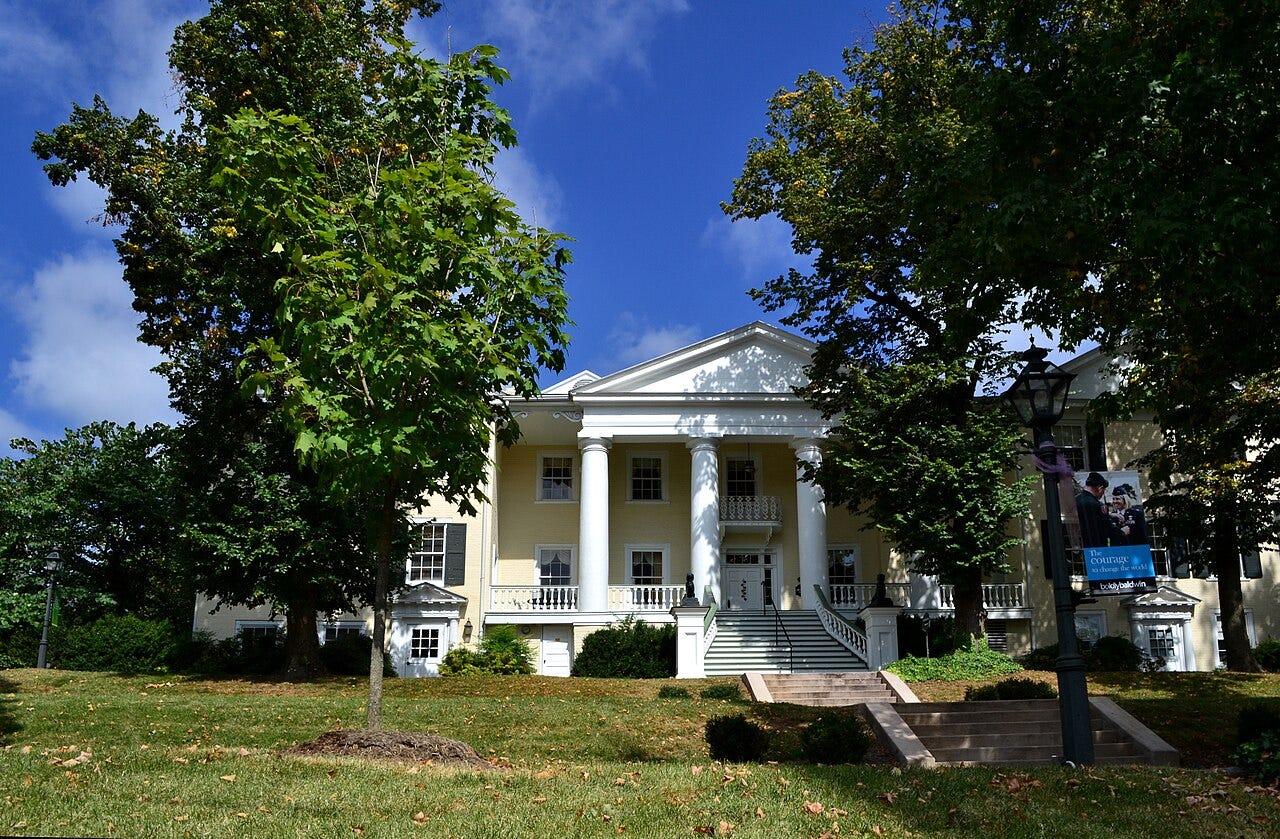
Mary Baldwin is not background scenery in Staunton. It occupies a significant portion of the city’s upper campus footprint, employs hundreds of people, draws students who live and spend money downtown, and feeds graduates into the regional workforce. The Murphy Deming College of Health Sciences at the Fishersville campus trains the nurses, physical therapists, and physician assistants who staff the Valley’s healthcare system.
What happens to Mary Baldwin matters here in ways that extend well past Frederick Street.
The university has been through difficult chapters before: the pivot from an all-women’s college to a coeducational university, the addition of graduate and doctoral programs, the expansion to the health sciences campus. Each required a degree of institutional reinvention. This moment asks for something more immediate, a demonstrable fix to the financial conditions that put it in SACSCOC’s crosshairs.
The next 12 months will say a great deal about whether that fix is coming.
Questions or tips on this story? Write to Brad at brad@stauntonian.com.